Resources and Facilities
MAPNA Boiler and Equipment Engineering and Manufacturing Company, relying on state-of-the-art technical knowledge, expert human resources, and the experience of Industrial project execution operates as an integrated and coordinated entity across the disciplines of basic design, process, structural, electrical, instrumentation and control, mechanical, piping, and equipment engineering. Utilizing state-of-the-art software, this company designs and executes projects and equipment with an approach centered on fulfilling technical requirements.
The pivotal role of the design and engineering divisions of MAPNA Boiler and Equipment Engineering and Manufacturing Company in improving technical specifications, enhancing the performance of existing products, and developing new products—by leveraging customer feedback and executed projects, as well as defining and implementing research and development plans, and acquiring state-of-the-art technical know-how and modern technologies—has enabled the sustained growth of this company in meeting client requirements with maximum flexibility.
Additionally, the company’s design department provides efficient and sustainable solutions for industries by focusing on increasing productivity, optimizing energy consumption, reducing operational expenditures, enhancing reliability, and complying with environmental requirements.
-683x1024.jpg)
The MAPNA Boiler manufacturing plant is situated on a 10-hectare plot of land with approximately 4 hectares of covered workshops equipped with state-of-the-art technologies, along with preparation, machining, welding, assembly, and finishing process lines.
In order to establish the infrastructural facilities required for executing development plans, the following measures have been taken:
Physical Development: Expansion of Warehousing and Production Shop Floors
Allocating a 22-hectare plot of land for the expansion of production areas and Warehouses
Construction of production halls in accordance with the company’s master development plan
Technological Development: Procurement of machinery, equipment, and tools, as well as upgrading existing machinery capabilities
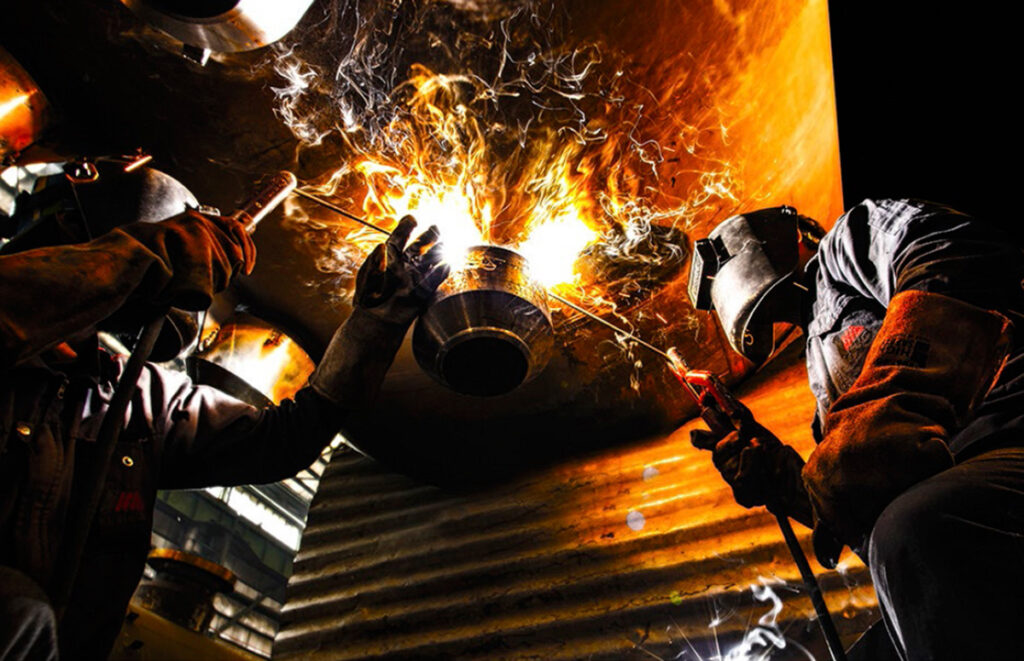
Utilizing cutting, rolling, forming, finning, dished end pressing, turning, milling, boring, vertical turning lathe (carousel), and welding equipment, along with blasting and painting, heat treatment furnace, normalizing, and hydrostatic testing facilities, the following manufacturing capabilities are available at MAPNA Boiler and Equipment Engineering and Manufacturing Co. with a production capacity exceeding 25,000 tons (expandable based on the product portfolio).
- Heavy plate rolling up to 300 mm thickness in hot condition and up to 180 mm thickness in cold condition using a 4-roll machine with a maximum working width of 4 meters
- Three-axis high-frequency induction bending of pipes used in power plant piping systems and oil and gas equipment from 4” to 32” in diameter
- Production of spiral finned tubes for manufacturing combined cycle harps and auxiliary boiler economizers up to 4” in diameter and 25 meters in length
- Continuous bending of superheater and economizer loops up to a maximum developed length of 76 meters and a loop length of 18 meters using a continuous pipe bending system with simultaneous X-ray testing capability
- Precision drilling and machining of steel structures in 7 axes using a CNC boring machine with a table working area of 4000*12000 mm, equipped with a universal head and boring head
- Vertical turning and facing of circular plates and structures up to 5 meters in diameter, 3.2 meters in height, and a load capacity of 60 tons using a vertical lathe (carousel)
- Welding of various pressure and non-pressure vessels using automatic submerged arc welding machines
- Individual pipe bending in sizes from 2” to 8” using CNC bending equipment
- Gang bending of finned tube panels used in boiler walls using CNC and portable equipment
- Stress relieving of steel structures up to 17 meters in length and 6 meters in width and height
- Automatic submerged arc welding of applied finned tube panels
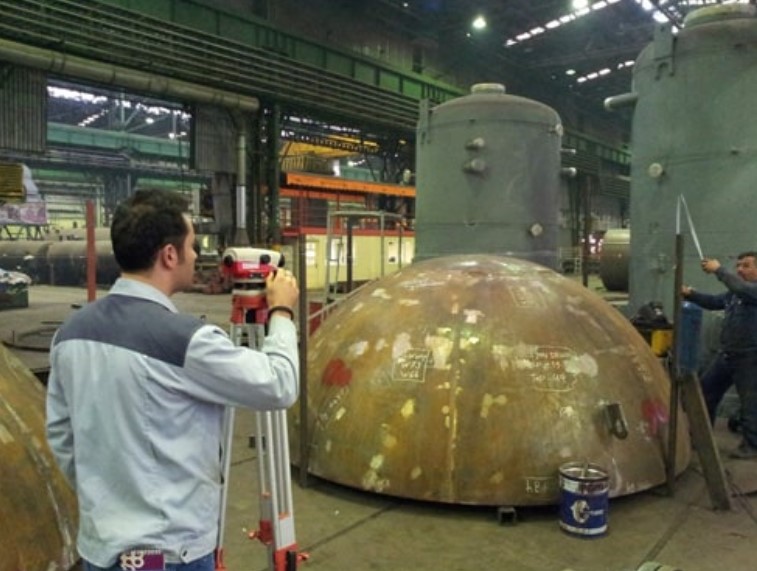
- Fabrication of ellipsoidal and spherical dished heads with a maximum diameter of approximately 6 m from plates with a maximum thickness of 60 mm
- Vertical bending of profiles and pipes up to a minimum clamping diameter of 600 mm
- Automated flame and plasma cutting (profile cutting) of carbon steel and alloy steel plates
- Hydrostatic testing of vessels, harps, and other high-pressure boundaries in dedicated stations in compliance with safety and environmental standards
- Shot blasting of materials, structures, and metallic products in an enclosed space measuring 20*6*6 m, equipped with filtration and waste recycling capabilities in compliance with environmental standards
- Heavy pressure vessel fabrication technology
- Utilization of welding technologies such as SAW, GTAW, GMAW, and SMAW
- Capability to cut various pipes and nozzles into customized profiles up to 6 m in length and 500 mm in diameter using a 5-axis cutting robot (oxy-fuel and plasma)
- Saddle-type beveling capability with configurable cutting parameters
- Vessel cutting capability utilizing a portable 3-axis vessel cutting robot with a maximum cutting diameter of 1 m
- CNC machining and beveling capability up to 7 m in length and 2 m in diameter using a DP heavy-duty lathe
- Fabrication and retubing technology for shell and tube heat exchangers
- Licensed for manufacturing Class E and F boilers along with sub- Relevant fabrications
- Capability to fabricate various power plant and refinery equipment skids
- Domestic manufacturing technology for knowledge-based products: Heat Tracing, Duct Burner, and Stack Damper
- Manufacturing technology for EDI and desalination products
in boiler walls
Engineering, quality control, and quality assurance of materials, equipment, and manufacturing operations at MAPNA Boiler and Equipment Engineering and Manufacturing Company are conducted by the independent management of “Product Quality Affairs”. Utilizing modern methods based on the latest editions of international standards such as AWS, ASTM, ASME, ISO, etc., this department is responsible for product quality.
Quality Control
- Technical inspection during the manufacturing process based on international standards
- Technical inspection (supervision, qualitative, and quantitative control) of purchased raw materials prior to shipment
- Evaluation of material suppliers and equipment manufacturers
- Supervision of proper execution of factory tests for the qualitative delivery of equipment
- Inspection of thermal and cold insulation
- Inspection of all coating systems for discontinuity (HOLIDAY TEST), thickness, and adhesion (field tests)

Welding, Materials, and Coating Engineering
- Preparation and development of quality control and inspection plans (ITP / QCP)
- Preparation of welding procedures (WPS, PQR, WPQ), heat treatment, hydrotest, NDT MAP, and painting/coating procedures based on ASME, AWS, EN, PD, ISO, NACE, SSPC, … standards
- Failure analysis of components
- Provision of repair procedures in welding and coating
- Material selection and estimation (welding and coating)
- Review of equipment Final Book
Product Quality Assurance
- Root cause analysis of non-conformities
- Promoting a quality culture within the organization based on Total Quality Management (TQM)
- Defining, measuring, and monitoring product quality indicators
- Identifying improvement opportunities related to Product quality

-766x1024.jpg)
Laboratory
Testing Laboratory: (Accredited under ISO 17025 standard by the National Accreditation Center of Iran)
- Specimen preparation using various equipment for cutting, machining, grinding, sanding, mounting, notching, and…
- Tensile and proof load testing of various specimens up to a force of 60 tons
- Nick Break, Break tests Test and Fracture Test on weld specimens in accordance with international standards
- Flattening, Flare Test, and Flange Test on pipe and tube specimens
- Bend test
- Impact test up to 300 Joules
- Macro hardness testing (Rockwell B, C, Brinell, and Vickers), Superficial, Micro (Vickers and Knoop), and Portable
- Chemical composition determination using stationary quantometry and portable XRF
- Macrography and metallography tests
- Non-destructive testing:
- Visual Examination
- Magnetic Particle Examination
- Penetrant Examination
- Radiographic Examination and radiographic film interpretation
- Ultrasonic Examination
- Advanced Ultrasonic (Phased Array & TOFD)
Calibration Laboratory
Dimensional Calibration
- Calipers
- Inside and outside micrometers
- Protractors
- Feeler gauges
- Spirit levels
- Industrial squares
- Rulers and measuring tapes
- Dial indicators
Pressure Calibration
- Pressure gauges up to 700 bar
- Transmitters up to 700 bar
- Transducers up to 700 bar
- Various types of Pressure gauges up to 350 bar
Temperature Calibration
- Furnace
- Oven
Electrical Quantity Calibration
- Pressure recorders
- Temperature recorders
Based on its vision document, MAPNA Boiler and Equipment Engineering and Manufacturing Company considers the use of Information and Communications Technology (ICT) as a fundamental principle to achieve defined objectives and enhance efficiency. In this regard, the company is moving toward maximizing its activities through ICT-based services. The deployment of IT equipment and services is aligned with the functional strategic objectives of ICT management and tailored to the company’s business. Their implementation is carried out based on systems management principles (the art and science of controlling and managing IT environments) and proven best practices implemented in reputable companies and organizations, aiming to increase efficiency and continuously improve work quality.
Hardware and Communication Capabilities
In the field of communications, by establishing a Metropolitan Area Network (MAN), the company has enabled interconnections between its Local Area Networks (LANs), realizing the intended objective. MAPNA Boiler and Equipment Company possesses the following facilities and capabilities:
- Two independent server farms at the factory and the Tehran office with mutual backup capabilities
- Data storage and backup system utilizing SAN Storage technology
- High-speed local area network (LAN) across all offices, warehouses, and workshops based on fiber-optic infrastructure
- High-speed fiber-optic and wireless regional network between offices
- High-speed internal wireless network with 300 Mbps bandwidth
- IP-PBX telecommunication centers at central offices and provision of telephony services to workshops via wireless regional network
- Robust and reliable infrastructure for conducting internal and external remote meetings utilizing Skype for Business
- Remote communication and teleworking capability for over 100 concurrent users at the plant site and Tehran office
- Utilization of advanced telecommunication technologies such as SIP Phone, Soft Phone, and Remote Extension
- Power infrastructure based on BICSI Tier 3 standards and power supply isolation for all IT equipment and server rooms utilizing Dynamic UPS technology and generator backup
- 11 advanced design computing centers utilizing IBM NeXtScale technology capable of processing computational meshes at a nominal speed of 14 TFlops
- High-level security for external communications utilizing Unified Threat Management hardware and software
- Implementation of Information Security Management System (ISMS) based on ISO 27001:2013 standard
- Providing more than 50 internal and remote services to 900 users aiming for 24*7*365 availability
- Utilization of inter-office video conferencing services to hold meetings at managerial and expert levels
- Deployment of an advanced data encryption system to enhance confidentiality levels and safeguard the organization’s key information assets
- Implementation of a comprehensive ICT service process management and automation system based on the Information Technology Infrastructure Library (ITIL) framework
- Employment of monitoring systems for real-time tracking of events, equipment and network service status, and periodic reporting
Software and System Capabilities
Since its inception, the company has procured or developed the information systems required across various process domains based on identified requirements. In line with realizing MAPNA Group’s policies on deploying the SAP ERP system across all group companies and in order to address the company’s need for integrated information systems, the SAP ERP system ECC 6 version was deployed in early 2015. This system was designed and developed based on global best practices and currently supports product lifecycle manufacturing processes, It is responsible for sales, procurement, warehousing, quality, logistics, and the company’s financial domain, as well as managing and streamlining the flow of information generated by various transactions across these processes. In addition to utilizing the integrated SAP system, a system known as MPI2 has been designed using the internal expertise and capacity of the Information Systems Development unit to support production and production planning processes, and is continuously developed to meet emerging requirements.
Information Systems Development Strategy Pyramid
The apex of this pyramid represents the strategy of utilizing internal capabilities and capacities in developing Decision Support Systems such as SAP BW and QlikView, and in the second layer known as Workflow Management Systems, the potential and capacity of the Information Systems Development unit are focused on the strategy of developing Non SAP systems on the Microsoft Dynamic 365 platform and implementing SAP Workflow. In the third layer, designated as the Transactional Management Systems layer, the implementation and deployment of the suite of SAP system modules and, within the production management and planning process domain, the MPI 2 system have been executed and are currently under development and operation.
MAPNA Boiler and Equipment Engineering and Manufacturing Company operates as an integrated and coordinated entity in the fields of basic design, process, structural, electrical, instrumentation and control, mechanical, piping, and equipment engineering, relying on state-of-the-art technical knowledge, specialized human resources, and industrial project execution experience. Leveraging cutting-edge software, the company designs and executes projects and equipment focused on meeting technical requirements.
The pivotal role of the design and engineering departments of MAPNA Boiler and Equipment Engineering and Manufacturing Company lies in improving technical specifications, enhancing the performance of current products, and developing new products by utilizing feedback from clients and executed projects, as well as defining and implementing R&D plans and identifying and acquiring up-to-date technical knowledge and modern global technologies. … has enabled the company’s growing trend in meeting customer requirements with maximum flexibility to continue.
Furthermore, the company’s design department provides efficient and sustainable solutions for industries by focusing on increasing productivity, optimizing energy consumption, reducing operational costs, enhancing reliability, and complying with environmental requirements.
The MAPNA Boiler manufacturing plant is located on a 10-hectare site with approximately 4 hectares of covered halls equipped with state-of-the-art technologies, including preparation, machining, welding, assembly, and finishing process lines.
In order to establish the infrastructural facilities required to implement development plans, the following measures have been undertaken:
Physical Development: Expansion of space Warehouses and Production Halls
Allocation of a 22-hectare plot of land for the expansion of production areas and warehouses
Construction of production halls in accordance with the company’s master development plan
Technological Development: Procurement of machinery, equipment, and tools, as well as upgrading existing machinery capabilities
Utilizing cutting, rolling, forming, finning, dished-head pressing, turning, milling, boring, carousel (vertical lathe), welding machinery, as well as blasting and painting, heat treatment furnaces, normalizing, and hydrotesting equipment, the following manufacturing capabilities with an annual production capacity exceeding 25,000 tons (with expansion capability based on the product portfolio) are available at the MAPNA Boiler and Equipment Engineering and Manufacturing plant.
- Heavy plate rolling up to a thickness of 300 mm in hot condition and up to a thickness of 180 mm in cold condition using 4-roll equipment and a maximum working width of 4 meters
- 3-axis high-frequency induction bending of pipes used in power plant piping systems and oil and gas equipment from 4″ to 32″ in diameter
- Production of spiral fin tubes for manufacturing combined cycle harps and auxiliary boiler economizers up to 4” in diameter and a length of 25 meters
- Continuous bending of superheater and economizer loops up to a maximum developed length of 76 meters and a loop length of 18 meters using a continuous tube bending system with concurrent X-ray testing capability
- Precision drilling and machining of steel structures across 7 axes using CNC boring equipment with working table dimensions of 4000*12000 mm, equipped with a universal head and boring head
- Vertical turning and facing of circular plates and structures up to 5 meters in diameter, a height of 3.2 meters, and a weight capacity of 60 tons using vertical boring mill (carousel) equipment
- Welding of various pressure and non-pressure vessels using automatic submerged arc welding machines
- Individual pipe bending in sizes from 2″ to 8″ using CNC bending equipment
- Gang bending of finned tube panels used in boiler walls using CNC and portable equipment
- Stress relieving of steel structures with a length of 17 meters and a width of and Height of 6 meters
- Automatic submerged arc welding (SAW) of finned tube panels used in boiler walls
- Fabrication of ellipsoidal and spherical dished heads with a maximum diameter of approximately 6 meters from plates with a maximum thickness of 60 mm
- Vertical bending of profiles and pipes up to a minimum clamping diameter of 600 mm
- Automatic flame and plasma shape-cutting of carbon steel and alloy steel plates
- Hydrostatic testing of vessels, harps, and other high-pressure components in dedicated stations in compliance with safety and environmental standards
- Shot blasting of materials, structures, and metallic products in an enclosed chamber with dimensions of 20*6*6 m, equipped with filtration and abrasive recycling capabilities, complying with environmental regulations
- Manufacturing technology for heavy pressure vessels
- Application of welding processes, including SAW, GTAW, GMAW, and SMAW
- Capability of custom-contour cutting for various pipes and nozzles up to 6 meters in length and 500 mm in diameter using a 5-axis cutting robot (oxy-fuel and plasma)
- Saddle beveling capability with customizable cutting parameters
- Vessel cutting capability using a portable 3-axis vessel-cutting robot with a maximum cutting diameter of 1 meter
- CNC machining and beveling capability up to 7 meters in length and 2 meters in diameter using a DP heavy-duty lathe
- Fabrication and retubing technology Shell and tube heat exchangers
- Possessing manufacturing licenses for E-Class and F-Class boilers along with the associated infrastructure
- Capability to fabricate various types of power plant and refinery equipment skids
- Domestic manufacturing technology for knowledge-based products, including Heat Tracing, Duct Burners, and Stack Dampers
- Manufacturing technology for EDI and desalination units
Engineering, quality control, and quality assurance of materials, equipment, and manufacturing operations at MAPNA Boiler and Equipment Engineering and Manufacturing Co. are carried out by the independent department of “Product Quality Affairs“. Utilizing modern methods based on the latest revisions of international standards such as AWS, ASTM, ASME, ISO, etc., this department is responsible for product quality.
Quality Control
- Technical inspection during the manufacturing process according to international standards
- Technical inspection (supervision, qualitative, and quantitative control) of procured raw materials prior to shipment
- Evaluation of vendors and equipment manufacturers
- Supervision of factory acceptance testing for the qualitative delivery of equipment
- Inspection of thermal and cryogenic insulations
- Inspection of all coating systems for discontinuity/pinholes (HOLIDAY TEST), thickness, and adhesion (field tests)
Welding, Materials, and Painting Engineering
- Preparation and development of various inspection and quality control stages (QCP, ITP)
- Preparation of welding procedures (WPS, PQR, WPQ), heat treatment, hydrotest, NDT MAP, and painting instructions based on ASME, AWS, EN, PD, ISO, NACE, SSPC, … standards
- Investigation of component failure causes (Failure Analysis)
- Providing repair procedures in the fields of welding and painting
- Material selection and estimation (welding and painting)
- Review of equipment final documentation (Final Book)
Product Quality Assurance
- Root cause analysis of non-conformities
- Cultivating a quality culture within the organization to execute activities based on Total Quality Management (TQM)
- Determining indicators product quality, along with its measurement and monitoring
- Identification of improvement opportunities related to product quality
Laboratory
Testing Laboratory: (Accredited under ISO 17025 standard by the National Accreditation Center of Iran)
- Sample preparation using various types of cutting, machining, grinding, sanding, mounting, notching equipment, etc.
- Tensile testing and Proof load testing of various specimens up to a force of 60 tons
- Nick-break, break test, and fracture tests on weld specimens in accordance with international standards
- Flattening, flare test, and flange test on pipe and tube specimens
- Bend test
- Impact test up to 300 Joules
- Macro hardness testing (Rockwell B & C, Brinell, and Vickers), superficial, micro (Vickers and Knoop), and portable hardness testing
- Chemical composition analysis by stationary spark OES and portable XRF methods
- Macrography and metallography tests
- Non-destructive testing (NDT):
- Visual Examination
- Magnetic Particle Examination
- Penetrant Examination
- Radiographic Examination and radiographic film interpretation
- Ultrasonic Examination
- Advanced Ultrasonic Testing (Phased Array & TOFD)
Calibration Laboratory
Dimensional Calibration
- Calipers
- Inside and outside micrometers
- Bevel protractors
- Feeler gauges
- Levels
- Industrial squares
- Rulers and measuring tapes
- Dial indicators
Pressure Calibration
- Pressure gauges up to 700 bar
- Transmitters up to 700 bar
- Transducers up to 700 bar
- Various types of pressure gauges up to 350 bar
Temperature Calibration
- Furnace
- Oven
Electrical Calibration
- Pressure recorders
- Temperature recorders
Based on its vision document, MAPNA Boiler and Equipment Engineering and Manufacturing Company considers the utilization of Information and Communications Technology (ICT) as a core principle to achieve defined goals and enhance efficiency. In this regard, the company is moving toward executing maximum operations via ICT-based services. The implementation of IT equipment and services is aligned with the functional strategic objectives of ICT management and tailored to the company’s business, deployed in accordance with systems management principles (the art and science of controlling and managing IT environments) and industry-proven best practices established in reputable organizations to boost productivity and continuously improve work quality.
Hardware and Communications Capabilities
In communications, deploying a Metropolitan Area Network (MAN) has enabled interconnectivity between internal Local Area Networks (LANs), fulfilling the intended principle. MAPNA Boiler and Equipment Company possesses the following facilities and capabilities:
- Two Independent server farm at the plant and Tehran office with mutual backup capability
- Data storage and backup system utilizing SAN Storage technology
- High-speed local area network across all offices, warehouses, and workshops based on fiber-optic infrastructure
- High-speed fiber-optic regional network and inter-office wireless network
- High-speed internal wireless network with a 300 Mbps bandwidth
- IP-PBX telecommunication centers at headquarters and provision of telephone services to workshops using a regional wireless network
- Robust and suitable infrastructure for holding remote meetings inside and outside the organization using Skype for Business service
- Remote communication and teleworking capability for over 100 concurrent users at the plant and Tehran office
- Utilization of advanced telecommunication technologies such as SIP Phone, Soft Phone, and Remote Extension
- Power infrastructure based on BICSI Tier 3 standard and power supply isolation for all IT equipment and the server room utilizing Dynamic UPS technology with generator backup
- 11 advanced design computing centers utilizing IBM NeXtScale technology with computational mesh solving capability at a nominal speed of 14 TFlops
- High-level security in external communications using Unified Threat hardware and software Management
- Implementation of the Information Security Management System (ISMS) based on the ISO 27001:2013 standard
- Providing over 50 internal and remote services to 900 users aiming for 24*7*365 availability
- Utilization of inter-office video conferencing services for conducting meetings at managerial and technical expert levels
- Deployment of an advanced data encryption system to enhance confidentiality levels and protect key organizational information assets
- Deployment of a comprehensive ICT service process management and automation system based on the Information Technology Infrastructure Library (ITIL) framework
- Utilization of monitoring systems for real-time tracking of events, equipment and network service status, and periodic reporting
Software and System Capabilities
Since its inception, the company has procured or developed required information systems across various process areas based on identified needs. In line with MAPNA Group policies regarding the deployment of the SAP ERP system across all group subsidiaries and in order to meet the company’s demand for integrated information systems, the SAP ERP system version ECC 6 has been deployed since early 2015. This system is designed based on global best practices and generated and currently responsible for supporting the company’s product lifecycle, sales, procurement, warehousing, quality, logistics, and financial processes, as well as managing and streamlining the information flow generated across various transactions within these processes. In addition to utilizing the integrated SAP system, a system designated as MPI 2 has been designed leveraging the internal capabilities and expertise of the Information Systems Development Department to support production and production planning processes, and continues to be developed in response to emerging requirements.
Information Systems Development Strategy Pyramid
The apex of this pyramid represents the strategy of leveraging internal capabilities and capacity in developing Decision Support Systems such as SAP BW and QlikView, and in the second layer, known as Workflow Management Systems, the capacity and potential of the Information Systems Development Department is focused on the development strategy for Non-SAP systems on the Microsoft Dynamics 365 platform and the implementation of SAP Workflow. In the third layer, designated as the Transactional Management Systems layer, the implementation and deployment of the suite of SAP system modules, as well as the execution of the MPI 2 system within the production management and planning process domain, have been carried out and is under development and production.