Sustainability and Social Responsibilities
The mission, vision, and core philosophy of MAPNA Boiler and Equipment Engineering and Manufacturing Company reflect our commitment to sustainability and social responsibilities. By focusing on clean energy, decarbonization, and water resource management, MAPNA Boiler seeks to create positive environmental and social impacts. This approach not only helps improve the company’s environmental performance, but also generates added value for all stakeholders and contributes to sustainable development. As a leading company in sustainability and social responsibility, MAPNA Boiler strives to establish a balance between industrial development and environmental protection.
Our Approach to Sustainability
Our approach to sustainability is a synergy of knowledge, industry, and responsibility; a path where economic progress, environmental preservation, and social accountability achieve sustainable balance.
Commitment to ESG Indicators
With regard to Environmental, Social, and Governance (ESG) indicators, MAPNA Boiler and Equipment Engineering and Manufacturing Company values business transparency and the satisfaction of all stakeholders, continuously striving to meet the diverse and varied needs of its audiences and stakeholders.
By complying with regulations and accepted social principles, this group seeks to increase the satisfaction of all stakeholders and fulfilling its corporate social responsibilities.
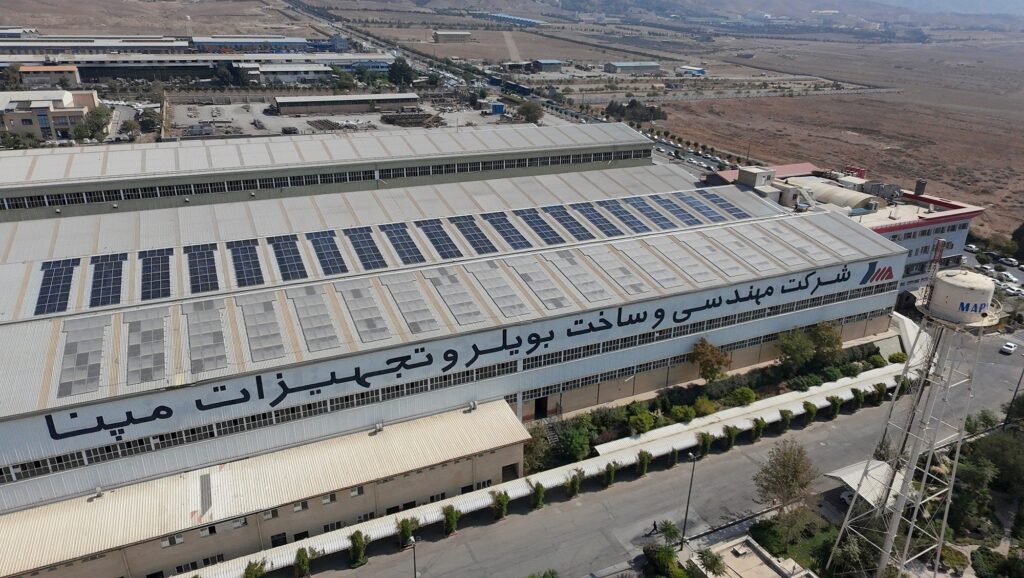
Guiding Pillars of Sustainability
Positive impact across three main areas
Social Responsibility
- Development of healthcare and wellness
- Provision of medical imaging equipment
- Supporting underprivileged regions
- Empowering disadvantaged groups
- Structuring charitable contributions
- Creating sustainable employment
Social Responsibility
- Clean energy management and generation
- Water resource management
- Air pollution reduction
- Environmental protection
- Renewable energy development
- Carbon footprint reduction
Environmental Sustainability
- Biodiversity conservation
- Waste Management
- Recycling and Reuse
- Reduction of Natural Resource Consumption
- Ecosystem Restoration
- Green Infrastructure Development
Key Sustainability Indicators
The figures demonstrate our commitment to sustainability
90 %
Reduction in Greenhouse Gas Emissions
5000 +
New Jobs Created
15
Active Clean Energy Projects
100 %
Commitment to ESG
Key Sustainability Projects
Our major contributions toward sustainable development
Lian Desalination Project
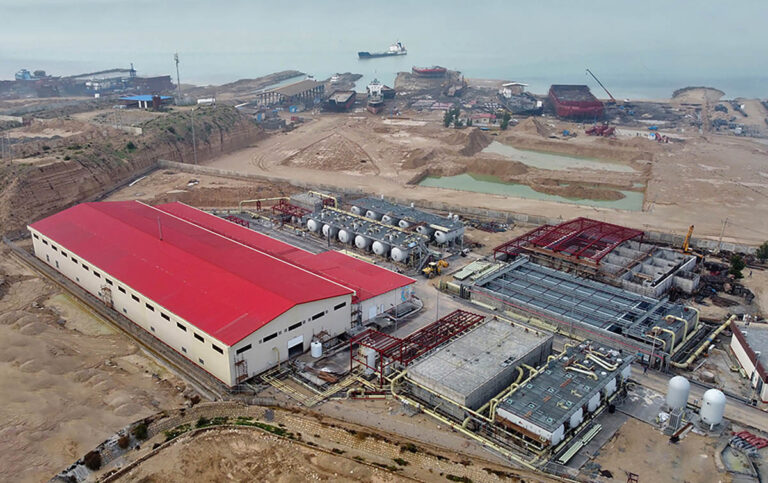
This project was defined and executed to produce 35,000 cubic meters per day of potable water sourced from the Persian Gulf. The seawater desalination technology used in this project is SWRO. The project execution site is Surtel Industrial Zone in the city of Bushehr.
. The objective of executing the project is to supply drinking water to a portion of the population of Bushehr city.
This project is the first seawater desalination project utilizing the membrane method (reverse osmosis) within the MAPNA Group, with all stages from design to installation and commissioning executed by specialists from MAPNA Boiler Company. The project supplies a significant portion of Bushehr Province’s drinking water and has been successfully and optimally implemented despite complex technical challenges regarding intake and pre-treatment due to the specific regional location and water quality conditions. In addition to reverse osmosis filters, a set of other equipment has been utilized, including a sedimentation system, dissolved air flotation (DAF), multimedia filters, and a complementary treatment system.
Project Name: | Lian |
Project Capacity (per day) | 35,000 cubic meters |
Raw Water Type | Seawater |
Project Type | EPC |
Client / Investee | MAPNA Group / Bushehr Water and Wastewater Company |
Technology | SWRO |
Pre-treatment System | Sedimentation+DAF+MMF |
Product Water Specifications | Potable Water |
Plant Wastewater Treatment Project
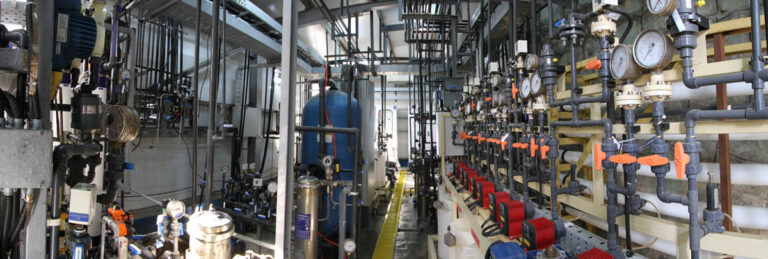
In line with adhering to its social responsibilities toward the environment and society, MAPNA Boiler reduced the need for groundwater extraction for green space irrigation to zero by commissioning a sanitary and industrial wastewater collection and treatment system at its plant through biological treatment and filtration. Furthermore, in 2019, by adding a complementary treatment system comprising coagulation, flocculation, and adsorption units, surface, ultrafiltration, reverse osmosis, and electrodeionization to this plant, fully produced its required industrial water from municipal and industrial wastewater, resulting in the demineralized water currently used in the plant being entirely obtained from treated effluent.
This project is also underway at the MAPNA Boiler Elahiyeh plant, and this successful experience has the potential to be expanded and applied across numerous industries, with the group fully prepared for its turnkey implementation.
Project Specifications
- Project Location: Alborz Province – MAPNA Boiler and Equipment Engineering and Manufacturing Co. Plant
- Project Capacity: 60 m³/day
- Raw Water Type: Sanitary and industrial wastewater
- Sanitary Treatment System Technology: Activated Sludge
- Advanced Treatment System Technology: DMF+CF+ACF+UF+RO+EDI
- Produced Water Specifications: Demin water with electrical conductivity of less than 0.1 μS/cm
- Allocated Area (Advanced Treatment System): 100 square meters
Plant Solar Cell Project
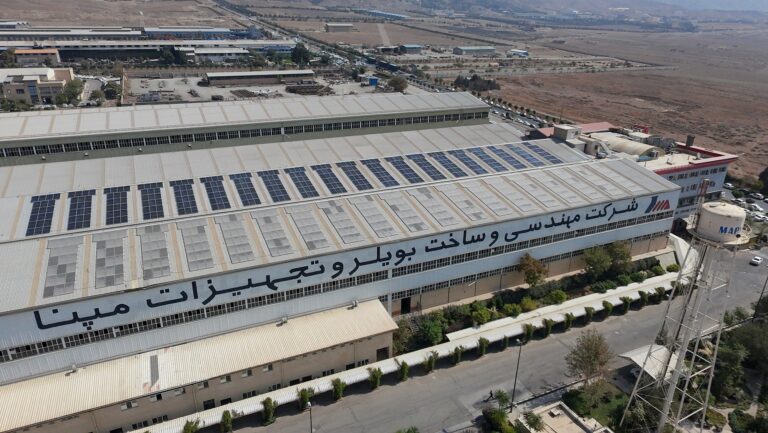
The 400 kW photovoltaic solar power plant of MAPNA Boiler Company has been constructed on the rooftops of several production halls to supply a portion of the factory’s electricity consumption from renewable energy sources (green electricity). By harnessing solar energy through approximately 730 photovoltaic panels with a nominal capacity of 550 W under standard conditions and an efficiency of about 21.3% installed on pitched roofs, approximately 400 kW DC of electrical power is generated. Transmitting this power to three inverters with a maximum capacity of 120kWac provides a total AC electrical energy of approximately 641 MWh per year for operational use in the factory.
Accordingly, in line with fulfilling the plan to increase the share of renewable energy in the electricity consumption of industrial units in country, the construction of this power plant is considered a valuable step toward reducing fossil fuel consumption in power generation, alleviating pressure on the regional power grid, ensuring production continuity and decreasing blackouts during peak grid demand hours, as well as reducing power imbalances and diesel consumption. In addition, from an environmental perspective, this project is recognized as an effective measure to reduce air pollution and greenhouse gas emissions compared to conventional grid electricity generation from fossil-fueled steam thermal and combined-cycle power plants.
Qeshm Combined Power and Water Project
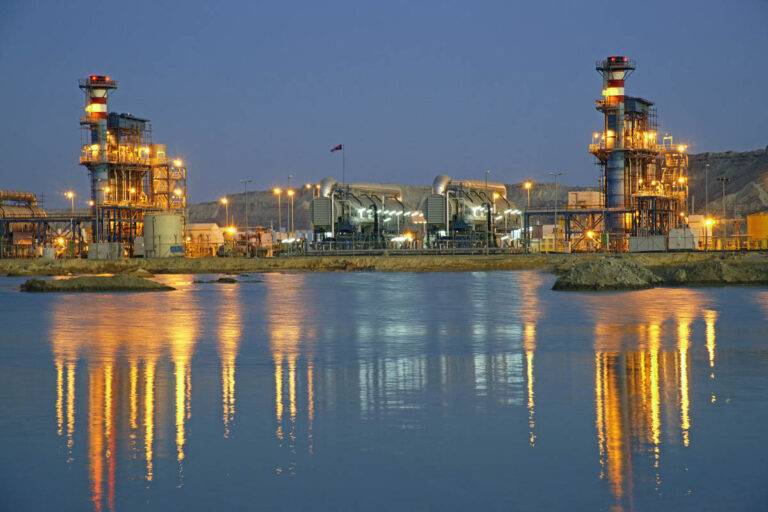
This project was established with the objective of constructing, developing, and operating a cogeneration (combined power and water) plant on Qeshm Island in Hormozgan Province. The project supplies 50 MW of electricity and 18,000 cubic meters of water per day to the residents of Iran’s largest island.
This power plant, funded by MAPNA Group investment was constructed and commissioned under a Build-Own-Operate (BOO) scheme in northern Qeshm Island, 750 meters from the sea. With the commissioning of the water section of this power plant, the residents of Qeshm villages, who make up approximately 70% of the island’s population, gained access to potable water for the first time.
Rudshur Combined Cycle Project
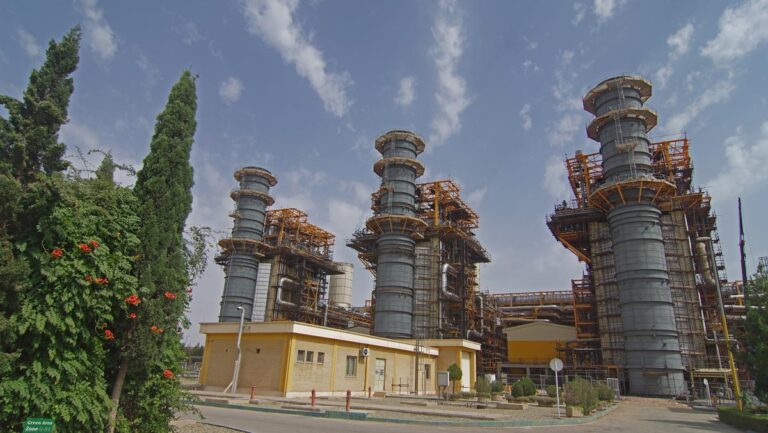
The Rudshur Combined Cycle Power Plant was executed by MAPNA Group under an EPC contract to expand power generation capacity in Zarandieh County, Markazi Province. Phase 1 of the power plant, with a nominal capacity of 792 MW, entered commercial operation in 2007. For the first time in the country, in this project featuring a 3-3-1 configuration (three gas turbines, three boilers, and one steam turbine), three gas units and … were interconnected into a steam unit. With the full implementation of this project, the final capacity of Roodshoor Power Plant increased to 1,134 MW. The steam unit of Roodshoor Power Plant yields annual fuel savings of 700 million cubic meters.
With the construction of this steam unit, the power plant’s efficiency increased to approximately 57 percent.
Low NOx Burner Products
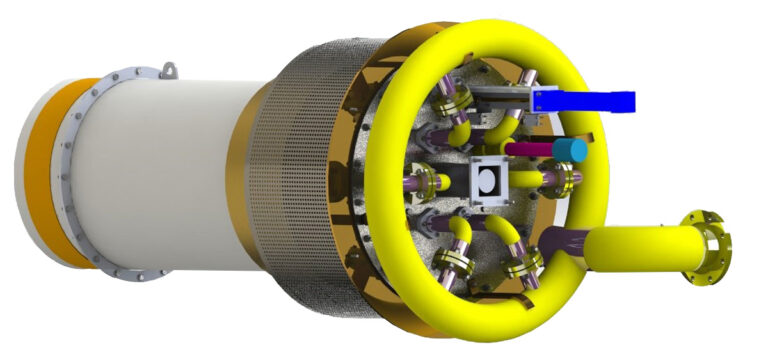
In the path of developing combustion technologies required by the boiler manufacturing industry, MAPNA Boiler has indigenized the knowledge of designing, analyzing, manufacturing, and testing industrial boiler burners with a thermal capacity of 20 to 70 MWth for various gaseous and liquid fuels, making them available to esteemed clients. By intelligently managing the fuel-air mixing process, Low NOx burners adjust combustion conditions to minimize emissions of pollutants, particularly nitrogen oxides. The company MAPNA Boiler has designed and manufactured three types of industrial and utility boiler burners to date.
The first type, or AS series, based on aerodynamic flame stability and precise control of flame dimensions; the second type, the MS series, focusing on ease of operation, emissions reduction, and flame dimension minimization; and the third type, the SF series, relying on flexibility and compatibility with diverse fuels including hydrogen and low-calorific-value fuels, have been designed and tested.
As the industry transitions toward clean and lower-carbon fuels, the development of hydrogen combustion technology has become a strategic necessity. Leveraging advanced combustion expertise, MAPNA Boiler has designed an Ultra Low NOx burner compatible with various gaseous fuels, particularly special fuels such as hydrogen, which is currently in the manufacturing phase. This burner has been developed based on MILD (Moderate or Intense Low-oxygen Dilution) combustion technology; an innovative approach that minimizes the formation of nitrogen oxide pollutants through the uniform distribution of the combustion reaction. In this design, NOx levels reach below 40 ppm under pure hydrogen combustion conditions.
Shared Steps for the Future
At MAPNA Boiler, we consider sustainability a replicable culture and believe that collective efforts can create a lasting legacy for future generations.
We eagerly welcome proposals We welcome initiatives that contribute to creating shared value and a sustainable future, and we believe in partnering with various organizations, companies, and institutions on the path toward sustainable development. If you have an idea or proposal in areas related to sustainability, we are ready to receive it and collaborate.
Proposal Areas:
- Renewable and emerging energy projects
- Environmental pollution reduction
- Corporate social responsibility programs
- Novel sustainable technologies
- Green investments
Submit your proposal to us by completing the form below. Our team will contact you as soon as possible.
Proposal Submission Form
Reports and Resources
Complete documentation of our sustainability and corporate social responsibility activities
Sustainability Reports
Comprehensive report on activities, achievements, and sustainability indicators from previous years Reports Archive
ESG Indicators
Detailed performance report on environmental, social, and governance indicators Download PDF
Certificates
International certificates and approvals in the field of sustainability and environment Download PDF